Report Horasis India Meeting, Singapore, 15-16 December

By Frank-Jürgen Richter
December 31, 2025
The 17th Horasis India Meeting took place in Singapore over 15–16 December 2025, co-hosted by the Global Schools Foundation (GSF) and the Confederation of Indian Industry (CII). Set on the Global Schools Campus – one of Singapore’s leading education and innovation environments – the meeting brought together around 300 senior leaders from India, Singapore, Southeast Asia, and the wider world. Across two days, participants examined how India’s accelerating economic momentum, Singapore’s role as a trusted global hub, and deeper alliances across the Global South could be leveraged to drive inclusive, sustainable development.
Atul Temurnikar, Executive Chairman, Global Schools Foundation, Singapore, welcoming participants
For more than a decade, the Horasis India Meeting has served as the foremost annual platform connecting Indian business leaders with global counterparts. This 2025 edition highlighted India’s growing self-confidence as a major growth engine, Singapore’s strategic role as a bridge across Asia, and the power of cooperation at a time when global challenges demand shared solutions.
India enters the mid-2020s with strong macroeconomic fundamentals, a rising middle class, and a rapidly maturing innovation ecosystem. Much of this momentum stems from the impact of digital public infrastructure, expanding manufacturing capacity, and an unprecedented scale-up of entrepreneurship across fintech, clean energy, agritech, healthtech, and deep tech.However, participants repeatedly emphasised that India’s long-term success depends on broad-based progress – ensuring that employment, skills, and social protection accelerate alongside GDP. Many highlighted that India’s demographic dividend will only materialise if its youth are equipped for an AI-enabled world. India’s global engagement is also changing shape. Leaders showcased how India’s alliances across Southeast Asia, the Gulf, Africa, and Latin America are deepening. Through connectivity, digital public goods, and political confidence, India is becoming a core actor in the evolving architecture of the Global South.
Palanivel Thiaga Rajan, Minister for Information Technology & Digital Services, Tamil Nadu
Singapore’s role as host underlined the strategic depth of Singapore–India relations. Built on more than three decades of collaboration – strengthened by CECA, multiple digital economy frameworks, and rising people-to-people ties – the partnership is today one of Asia’s most resilient. Singapore remains the preferred regional base for Indian companies seeking to expand across ASEAN. Indian corporates have located their Asia–Pacific treasury centres, headquarters, and innovation labs in Singapore, while Singaporean investors increasingly view India as a growth anchor in areas including renewables, defence manufacturing, logistics, infrastructure, education, and healthcare. Throughout the meeting, participants highlighted how India’s scale and innovation combined with Singapore’s governance excellence, connectivity, and neutrality created an ideal platform for co-creation across emerging sectors – AI, green energy, education, logistics, and digital finance.
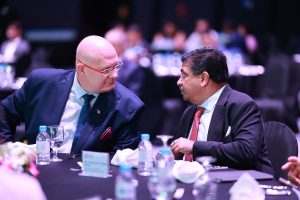
Deputy Minister Michal Gramatyka and Minister Palanivel Thiaga Rajan
In the opening plenary on ‘India’s Expanding Role in a Changing World’, moderator Atul Temurnikar, Chairman, Global Schools Foundation, Singapore, opened with an extended reflection on India’s rise that set both the emotional and strategic tone for the meeting. He argued that India’s ascent is rooted in a long arc of educational investment, cultural resilience, and sustained societal ambition. As he noted, “India’s journey toward global leadership is not the story of a single decade or a single policy. It is the cumulative outcome of generations seeking knowledge, valuing learning, and building institutions capable of adapting to change. When a nation equips its young minds with both skills and values, global influence becomes a natural consequence rather than an aspiration.” Building on this foundation, Murali Krishna Gannamani, Chief Executive Officer and Managing Director, Fluentgrid, India, highlighted how digital public infrastructure and state-level innovation are accelerating India’s transformation. He argued that India’s strength lies not only in scale, but in its ability to operationalise reform through technology-driven governance. “India is demonstrating that digital systems can be instruments of inclusion, not exclusion. When platforms are designed for scale, transparency, and access, they do more than deliver services – they build trust between citizens, markets, and institutions.” His remarks underscored how technology is becoming a central pillar of India’s global credibility.
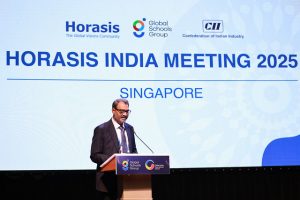
Murali Krishna Gannamani, Chief Executive Officer and Managing Director, Fluentgrid, India
Adding a broader geopolitical perspective, Gulu Lalvani, Chairman, Royal Phuket Marina, Thailand, observed that India’s growing confidence is now visible in boardrooms, policy forums, and international negotiations alike. He noted that India’s diaspora, economic weight, and technological depth have collectively reshaped global expectations. “India is no longer seeking invitations; it is shaping the agenda. The world senses a different India – more assured, more outward-looking, and more willing to lead.” From a policymaker’s standpoint, Shweta Shalini, Maharashtra Spokesperson, Bhartiya Janta Party, India, emphasised that India’s global rise must remain anchored in social stability and opportunity creation. She stressed that reform momentum must translate into broad-based progress, warning that growth which fails to carry people along ultimately undermines itself. As she put it, “Sustainable leadership comes from aligning economic ambition with social confidence. When people feel included in progress, reform gains legitimacy and durability.” Together, the speakers framed India’s expanding global role not simply as an economic story, but as a convergence of education, technology, governance, and social trust. The discussion invited participants to view India’s leadership in the world through a wider lens – one that balances ambition with responsibility, scale with inclusion, and growth with long-term societal resilience.

Shweta Shalini, Maharashtra Spokesperson, Bhartiya Janta Party, India
Palanivel Thiaga Rajan, Minister for Information Technology and Digital Services, Government of Tamil Nadu, India, explained that Tamil Nadu today represents the second-largest state economy in India and is pursuing sustained double-digit growth. He positioned the state as one of the country’s most attractive investment destinations, underpinned by strong industrial foundations, skilled human capital, and policy continuity. Central to this strategy, he noted, is digitalisation, which has become a powerful catalyst for employment generation, productivity gains, and inclusive economic development. By embedding digital platforms across public services, manufacturing, and urban infrastructure, Tamil Nadu is accelerating ease of doing business while simultaneously expanding opportunities for SMEs, startups, and young talent. In his view, the state’s ability to combine scale with governance efficiency and technology-led reform makes it a model for how sub-national economies can drive national growth in an increasingly competitive global landscape.
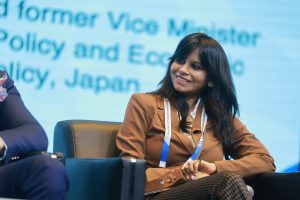
Suruchii Suresh Gupta, Founder and Chief Executive Officer, GIANT Protocol, USA
A dedicated exchange also took place with a Polish delegation led by Michał Gramatyka, Deputy Minister for Digital Affairs of Poland, who joined the Horasis India Meeting to explore new avenues for cooperation with India, and with the state of Tamil Nadu in particular. Discussions focused on digital governance, deep-tech collaboration, and industrial digitalisation, with both sides recognising strong complementarities between Poland’s technology capabilities and India’s scale, talent base, and reform momentum. Tamil Nadu was highlighted as a natural entry point for Polish companies, given its advanced manufacturing ecosystem, fast-growing digital infrastructure, and proactive approach to innovation-led development. The dialogue underscored a shared interest in translating bilateral goodwill into concrete partnerships across digital services, smart industry, and skills development.
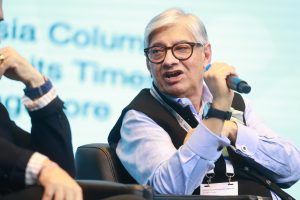
Rajive Kaul, Chairman, Nicco Group, India
In the plenary session on ESG in the Age of AI, moderator Girish Ramachandran, President of Growth Markets, Tata Consultancy Services, Singapore opened with an extended provocation: that the coming decade will test not technology, but the quality of human stewardship. He said that while AI has placed immense analytical power in the hands of governments and enterprises, its impact will depend entirely on the intentions of those deploying it. “Technology,” he reminded the audience, “is neutral only in theory. In practice, it reflects the choices, courage, and convictions of the leaders who guide it. AI can drive sustainability, but it can also accelerate waste and inequality. The responsibility lies squarely with us. – exposing supply chain gaps, carbon footprints, and labour risks with unprecedented clarity. Ko Kheng Hwa, Chairman, Univers, Singapore warned that transparency alone is insufficient, saying indirectly that too many organisations still treat disclosure as performance. Adding a geopolitical and international governance angle, Mike Liu, Vice President and Senior Fellow, Center for China and Globalization, China argued that AI has the potential to reduce mistrust between nations, but only if common standards are created. He noted that across Asia’s major economies, technologists and policymakers are asking variations of the same questions regarding data sovereignty, fairness, and resilience. As he framed it, “AI gives us a rare alignment of interests across the region. If we use it wisely, it can become the backbone of cooperation — not competition.” From this foundation, Diana Sabrain, Co-founder, OneAgrix, Singapore elaborated on the relationship between transparency and action. She argued that AI could dismantle long-standing information asymmetries – “AI must help us do both.” The panel concluded that ESG in the AI era requires multilevel action: from ethical governance frameworks to regionally harmonised protocols, and from corporate responsibility to community inclusion. The real promise of AI lies not in efficiency alone, but in enabling better choices – choices rooted in accountability, compassion, and long-term thinking.
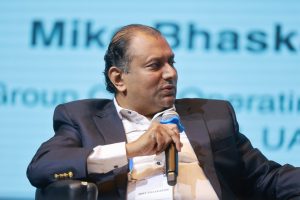
Mike Bhaskaran, Group Chief Operating Officer, DP World, UAE
In contrast, Nguyen Quang Huan, Chairman, Halcom, Vietnam grounded the discussion in the realities of emerging economies. He emphasised that climate action cannot be separated from development needs, arguing that many countries in Asia face simultaneous challenges of industrialisation, poverty reduction, and environmental stress. His view was clear: “We cannot afford to debate whether we prioritise people or the planet. In our region the only viable solution is to uplift communities while reducing emissions.
On the plenary panel on the ‘World Economic Outlook’, moderator Richard Hames, President and Founder, Asian Foresight Institute, Thailand opened with a sweeping systems-level view of global turbulence. He suggested that traditional forecasting methods are becoming obsolete in a world defined by non-linear shocks, arguing that societies must now invest in adaptive capacity rather than prediction. As he put it, “the future is arriving faster than our models can process. What matters is not certainty, but preparedness — and in this, both India and Singapore excel.” Turning the conversation toward equity, Vinod Sekhar, Chairman, Petra Group, Malaysia insisted that economic planning must be grounded in a new ethic of social responsibility. He warned that pursuing climate goals without addressing inequality would produce fragile societies. His message was emphatic: “It is not enough to build a greener world; we must also build a fairer one. Prosperity and justice must rise together.”

Closing Plenary ‘Shaping a Shared Future through Entrepreneurship’
Expanding this perspective, Lisa Botos, Founding Partner, Private Partners & Co, Singapore noted that sustainability is increasingly inseparable from competitiveness. She explained that companies who invest in green transformation are often the ones that innovate fastest and anticipate future regulation most effectively. “Going green,” she said, “is not a concession — it is a strategic necessity, and those who embrace it will lead in the decades to come.” Anil Wadhwa, Former Secretary, Ministry of External Affairs and Ambassador of India to Italy, Thailand, Oman and Poland, India added that globalisation is not retreating – it is being rewired, and India and Singapore are central to the new architecture. Drawing from his work on global connectivity, Parag Khanna, Founder and Chief Executive Officer, AlphaGeo, Singapore then argued that the economic future of Asia will be shaped not by geopolitics alone but by the depth of infrastructure, digital, and financial linkages across the region. He reflected that, “as India and Southeast Asia join their economic destinies through supply chains, trade corridors, and data flows, we enable a more resilient and multipolar global system.”
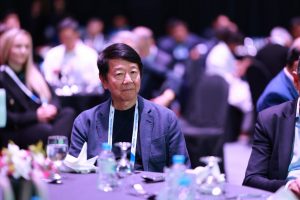
Tan Chin Nam, Chairman, Global Fusion Capital, Singapore
In the plenary on ‘Shaping the Future through Responsible Technology’, moderator Preity Üpala, Founder, The Omnia Institute, India opened with a philosophical reflection that set a contemplative tone. She suggested that technology is fundamentally neutral until animated by human intention. “If our intention is fear, we will build systems that divide. If our intention is wisdom, we will use AI to build bridges lagged behind technological breakthroughs, from early digital services to today’s AI deployments. This, Srini Vasan, President and Chief Executive Officer, Quantum Ventura Inc, USA argued, places an even greater responsibility on designers and leaders. He noted indirectly that digital ubiquity demands an ethical core, saying, “We must ensure that as the world becomes digital by default, our values do not become optional by default.” In the domain of global trade, Mike Bhaskaran, Group Chief Operating Officer, DP World, UAE cautioned against a narrow focus on operational efficiency. He argued that AI has the capacity to reduce emissions, streamline logistics, and expand inclusion – if used thoughtfully. “The real promise of AI,” he said, “lies in creating supply chains that are transparent, sustainable, and accessible – especially for the thousands of SMEs who have historically been left behind.”
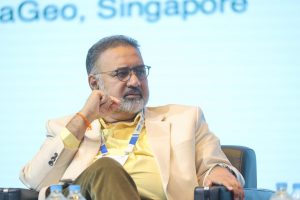
Vinod Sekhar, Chairman, Petra Group, Malaysia
From the venture capital side, Tan Yinglan, Founding Managing Partner, Insignia Ventures Partners, Singapore stressed the importance of governance, describing the need for mature, intentional investment cultures. He warned that cycles of overfunding and underfunding have distorted regional innovation ecosystems. “Patient, principled capital,” he insisted, “is the foundation of responsible technology. Without it, growth becomes volatility, and innovation becomes fragility.” Chandrakanth B. N., Founder and Chief Executive Officer, Pairee, India built on this by tracing the arc of digital evolution. He noted that regulatory systems have repeatedly has to reward long-term resilience over short-term speculation in AI ventures. The session closed with a powerful consensus: the future of responsible technology will depend not only on innovation, but on ethical clarity, global coordination, and human courage.

Girish Ramachandran and Frank-Jürgen Richter launching Horasis Social
In the plenary session on ‘Shaping a Shared Future through Entrepreneurship’, moderator Ravi Velloor, Senior Asia Columnist, The Straits Times, Singapore situated the conversation in the emerging narrative of “Asian opportunity.” He noted that India’s entrepreneurial surge is not an isolated phenomenon but part of a broader continental story – one driven by demographic energy, digital connectivity, and cultural confidence. “India’s entrepreneurs,” he said, “are writing one of the defining chapters of Asian modernity. Their success will hinge on how well we connect them to the region’s wider economic bloodstream, especially through nodes like Singapore.” As Suruchii Suresh Gupta, Founder and Chief Executive Officer, GIANT Protocol, USA, put it, “Resilience is a capability that travels. What works in fragile environments can work anywhere.” From the vantage point of frontier markets, Fahim Hashimy, Chairman, Hashimi Group; Former Minister of Communications and Information illustrated how innovation often emerges from adversity. He explained that solutions designed to function under resource constraints, political volatility, or institutional fragility tend to be inherently robust and adaptable. In his view, “entrepreneurs who build for uncertainty develop instincts for resilience, efficiency, and relevance – qualities that travel well across borders and make such solutions globally competitive.”
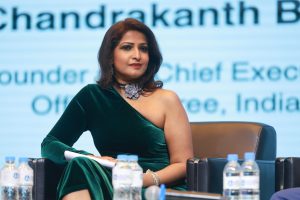
Preity Üpala, Founder, The Omnia Institute, chairing a panel
Adding an industrial policy perspective, Rajive Kaul, Chairman, Nicco Group, India remarked that globalisation is undergoing fundamental restructuring – not retreating. He suggested that India’s unique strength lies in its vast talent pool, while Singapore offers governance precision and global connectivity. He argued that, “together, our ecosystems can produce value chains that are more resilient, more innovative, and more ethical than those built in the past.” Kotaro Tamura, Senator and former Vice Minister for Fiscal Policy and Economic Policy, Japan brought in a policy innovation lens, stressing that governments must shift from “industrial policy” to “entrepreneurial policy.” He argued that modern competitiveness requires talent mobility, permissionless experimentation, and the free flow of capital and ideas. “The next era of growth,” he noted, “will be shaped by countries that welcome entrepreneurs rather than merely regulate them.” The overall narrative that emerged was that the future of entrepreneurship will depend on cross-border ecosystems, resilient founders, and investment cultures that support long-term creation rather than short-term speculation.
At the Closing Dinner, Palanivel Thiaga Rajan, Minister for Information Technology & Digital Services, Government of Tamil Nadu, India reflected that India sees Singapore not only as a strategic partner but as a force multiplier in Asia. He emphasised that India’s digital public goods, manufacturing reforms, and climate ambitions could significantly benefit from Singapore’s strengths. He underlined that “our countries share a commitment to fair, sustainable, and trusted globalisation – and this partnership will help shape Asia’s next chapter.”

Parag Khanna, Founder and Chief Executive Officer, AlphaGeo, Singapore
The summit introduced Horasis Social, the new Horasis Digital Platform, co-created with TCS – a tool envisioned to sustain collaboration well beyond the summit. Launching the platform, Girish Ramachandran, President of Growth Markets, Tata Consultancy Services, Singapore reflected on a longstanding challenge of global convenings: the disconnect between powerful discussions and long-term implementation. He explained that the platform was designed to bridge that gap, remarking that “ideas are most fragile right after they are spoken – unless they are captured, nurtured, and tested with others. This platform is our bridge between inspiration and execution.” Taking the broader view, Frank-Jürgen Richter, Chairman, Horasis described the platform as an evolution of Horasis itself. He noted that Horasis has always aimed to cultivate a global community built on trust, curiosity, and cooperation. The digital platform, he said, “allows us to extend that spirit across time and geography, turning our meetings into an ongoing conversation, one that is enriched by continuity rather than limited by calendars.” This session marked the beginning of Horasis’ transformation from a periodic forum into a permanent, worldwide collaboration ecosystem.
Across two days of intensive dialogue, the 17th Horasis India Meeting demonstrated the power of structured cooperation between India, Singapore, and the Global South. The meeting highlighted India’s growing role as a global growth engine, Singapore’s position as a stable and trusted regional hub, and Horasis’ mission to convene leaders committed to shaping a more inclusive and forward-looking world. Horasis looks forward to welcoming participants to the next edition of the Horasis India Meeting, continuing its mission to inspire the future through visionary collaboration.