Harnessing the Power of Cooperation – Report of the Horasis Global Summit 2025, Sao Paulo, 7-9 October

By Frank-Jürgen Richter
October 19, 2025
The 10th Horasis Global Summit took place in São Paulo, Brazil, hosted by the University of São Paulo (USP). Recognized as Brazil’s foremost public university and a long-standing inspiration for research and innovation, USP provided an ideal setting for a summit dedicated to cooperation and shared progress. The Horasis Global Summit 2025 in Brazil was not only the largest Horasis meeting ever held – 1000 speakers from 50 countries joined – it also marked twenty years since the launch of the Horasis Global Visions Community. For two decades, Horasis has served as a space where global visionaries exchange ideas and co-create pathways toward a fairer and more sustainable future. The 2025 focus on “Harnessing the Power of Cooperation” could not have been timelier. As societies struggle with fragmentation, climate disruption, and technological acceleration, cooperation stands out as both a necessity and a moral imperative.
Jorge Lima, State Secretary for Economic Development, State of Sao Paulo
Felício Ramuth, Vice Governor of the State of São Paulo opened the Summit describing São Paulo as a laboratory for the nation’s future, a state whose size and diversity demand inclusive governance. “This is a historic moment to invest in Brazil,” he declared, “as our tax reform opens new space for innovation, efficiency, and fairness. Jorge Lima, Secretary of Economic Development, State of São Paulo reminded the audience that economic transformation depends as much on ethics as on engineering. “The São Paulo I want is one where every citizen can reach their maximum potential and feel increasingly proud of their State,” he said. Carlos Gilberto Carlotti, Rector of the University of São Paulo, added a distinctly academic cadence to the dialogue. He spoke of the university’s autonomy not as privilege but as public trust. “Universities need academic freedom to thrive,” he said. “Autonomy imposes itself as a rational assumption for the generation of knowledge.”
The plenary panel Harnessing the Power of Cooperation, examined how collaboration can be translated into effective structures for governance, business, and society. The session was chaired by Kyle Bozentko, Executive Director of the Center for New Democratic Processes in the United States, who emphasized that democracy itself must become more deliberative and inclusive. Maria Cristina Frias, Partner at Grupo Folha in Brazil, discussed the strategic direction of media and journalism’s essential role in promoting understanding among nations. “Good storytelling opens a clear focus in complex issues,” she said, while noting that there is “a decline of cooperation among countries” and a growing polarization of information. Sekai Holland, Chairperson of the Board of Trustees of the Zimbabwe Peacebuilding Initiative and Former Minister of State for National Healing, Reconciliation and Integration of Zimbabwe, closed the discussion by highlighting the moral dimension of cooperation. She emphasized that peace cannot be imposed but must be cultivated through dialogue and respect for history.
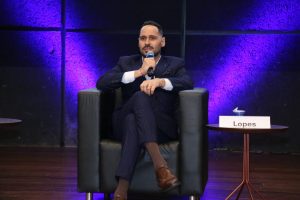
Pedro Lopes, Secretary of State of Digital Economy, Cape Verde
The second plenary panel examined the World Economic Outlook, focusing on how cooperation can help stabilize a global economy marked by technological disruption, geopolitical uncertainty, and structural transformation. The discussion was chaired by Ligia Guimarães, Editor of Valor Econômico in Brazil, who opened by reflecting on the responsibility of economic journalism to provide accuracy and perspective in a volatile world. Lucas Ferraz, Former Secretary of Foreign Trade and Professor at Fundação Getulio Vargas in Brazil, addressed the dynamics of international commerce. He observed that Brazilian exports to Asia could help mitigate the forecast decline in Brazil’s trade surplus this year, demonstrating the country’s capacity to diversify and adapt. From the financial sector, Kaspar Grathwohl, Executive Vice Chairman of UBS in Switzerland, outlined the major trends shaping global wealth management and investment banking. He noted that investors today face a complex intersection of digitalization, demographic shifts, and new forms of risk. Claude Béglé, Chairman of SymbioSwiss in Switzerland, pointed to innovation as the primary driver of future growth. “Innovation is the best opportunity we have to grow the economy,” he said, emphasizing the speed of change driven by digital technologies and Artificial Intelligence. Adding a perspective from Latin America’s banking sector, Alejandro Valenzuela, Chief Executive Officer, Banco Azteca, Mexico, described how financial technology is transforming transactions and consumer behavior. “There is a revolution coming in financial transactions,” he said, “and a key requirement will be cybersecurity.”
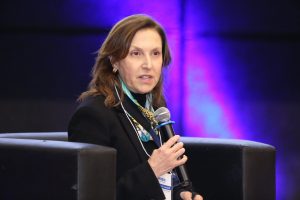
Maria Cristina Frias, Partner, Grupo Folha, Brazil
A further plenary panel addressed one of the defining challenges of our time: Rethinking Climate Cooperation. The session was chaired by Nisaa Jetha, Founder, ImpactforSDGs, United Kingdom, whose work focuses on impact strategy, accountability, and the pace of delivery for the United Nations Sustainable Development Goals (SDGs). She emphasized that cooperation in climate policy must bridge the gap between capital and conscience – between financial systems and moral responsibility. Sarah Siquieira, Founder, Rampa, Brazil, spoke about the crucial role of scientific research in addressing environmental challenges. Drawing from her experience with collaborative projects at SERC, she emphasized how interdisciplinary science can illuminate the long-term effects of human activity on ecosystems. She urged for stronger links between research institutions, industry, and government to ensure that science guides sustainable policy. Gladys Martínez, Chief Executive Officer, Interamerican Association for Environmental Defense, Costa Rica, expanded the discussion to include marine ecosystems. “With the accelerating climate and biodiversity crises,” she warned, “time is not a luxury — we have to put ocean health back on track.” Adding a creative and humanistic perspective, Juliana Schürmann, Co-founder and President, Impact Coalition Institute, Brazil, reflected on her work as an architect, entrepreneur, and environmental advocate. Her approach focuses on mobilizing people and institutions into collective action. “We need to unite people, ideas, and actions to restore the planet,” she said.
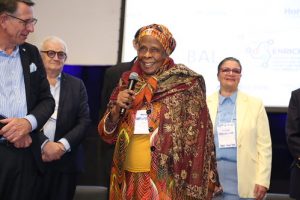
Sekai Holland, Chairperson of Board of Trustees, Zimbabwe Peacebuilding Initiative
The session Leveraging Technology for Humanity’s Progress brought together leaders from journalism, technology, industry, and innovation to examine how digital transformation can be aligned with human values. Drawing on her experience as a journalist operating at the intersection of technology and truth, session chair Jessica Brice, Senior Investigative Reporter, Bloomberg News, USA reflected on the shifting balance between transparency and privacy. “If we want protection,” she said, “we need to start thinking of our data also as our property, because it is unlike [bricks and mortar] property which is protected legally.” She argued that data has become the world’s most valuable asset — a resource that empowers innovation but also exposes societies to new forms of vulnerability. Carlos Creus Moreira, Founder and Chairman, WISeKey, Switzerland, built on this idea, warning that digital abundance has created a paradox of disconnection. “We’re getting digital fat,” he said, describing how the overproduction of information risks eroding individual autonomy. Raj Nandwani, Managing Director, Advane, Hong Kong, shifted the discussion toward the moral dimension of technological change. “We need to use technology to build empathy,” he said, “because too often it removes empathy from the world.” From the perspective of industry transformation, Rüdiger Leutz, Managing Director, Porsche Consulting, Brazil, highlighted Brazil’s culture of resilience as a model for adaptive innovation. “Brazilians are not known for sticking their heads in the sand,” he said, “but for pulling together.” Ani Chahal Honan, Founder, Yunity, USA emphasized that technology should serve as an amplifier of human connection, not as its replacement. “We are standing at a threshold,” she said, “where our tools are evolving faster than our collective wisdom.
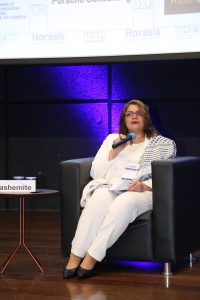
HH Princess Nisreen El-Hashemite, Executive Director, Royal Academy of Science Inter. Trust, USA
The session Achieving Peace in a Fragmented Worl, addressed one of the most urgent and complex challenges facing the international community. Bringing together leaders from government, business, and diplomacy, the session explored how cooperation and accountability can rebuild trust in an era marked by conflict, division, and disinformation. The discussion was chaired by Rhett Power, Forbes Columnist and Chief Executive Officer, Accountability Inc, USA, who began by emphasizing that accountability is not a constraint but the foundation of leadership. “Accountability,” he said, “is the true driver of success. Sundeep Waslekar, President, Strategic Foresight Group, India, broadened the conversation to the global level, arguing that the economics of peace are often underestimated. Drawing on decades of work in foresight and conflict resolution, he noted that cooperation and preventive diplomacy can drastically reduce the human and financial cost of wars. “Every dollar spent on foresight saves a hundred in recovery,” he observed. “Global cooperation is not only a moral necessity; it is sound economic policy.” He urged participants to view peace as a shared investment rather than a political aspiration – one that demands long-term vision and institutional cooperation. Jerry Hultin, Chief Executive Officer, Global Futures Group, USA, added a forward-looking dimension, connecting security to innovation. He argued that technology and peacebuilding must evolve in tandem: “If we want peace to be sustainable, we must embed it into the design of our systems – in the way we govern AI, manage resources, and educate future leaders.” From his experience in public service, Tobias Ellwood, Former Minister for Defence and Foreign Affairs, United Kingdom, reminded the audience that peacebuilding also requires compassion toward those who have borne the cost of conflict.
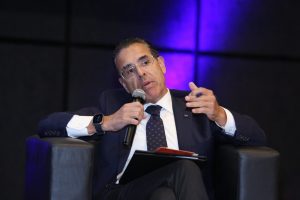
Alejandro Valenzuela, Chief Executive Officer, Banco Azteca, Mexico, one of the meeting co-chairs
Drawing on his work with military veterans, he emphasized that “the physical and mental wounds should be treated the same.” The discussion concluded with a powerful appeal from Her Highness Princess Nisreen El-Hashemite, Executive Director, Royal Academy of Science International Trust, USA, who spoke passionately about equality and dignity as the foundations of peace. She warned that “dialogue is most perilous today, as there is no trust in international cooperation mechanisms,” yet insisted that trust can only be rebuilt through persistent engagement and inclusion. Together, the panelists converged on a clear conclusion: that peace is inseparable from cooperation, and cooperation is inseparable from accountability. From boardrooms to battlefields, from digital platforms to diplomatic tables, the cultivation of trust remains humanity’s most demanding – and most necessary – task.
The final plenary of the day, Economic Development in the Age of Cooperation, brought the conversation full circle – from geopolitics and peacebuilding to the concrete mechanisms that translate vision into progress. The dialogue examined how entrepreneurship, healthcare, and investment can converge to drive inclusive growth when guided by integrity and cooperation. The session was chaired by Steven Ogunro, Managing Partner, Late Stage Venture Partners, USA, whose career embodies the principle that the world’s most pressing problems can become its most transformative opportunities. “The world’s most important stories,” he said, “are also its most investable ideas.” Sai Kumaran, Partner, CrossWork Ventures, USA, followed with pragmatic advice for new entrepreneurs. He emphasized that cooperation begins with discipline and transparency in building strong foundations.
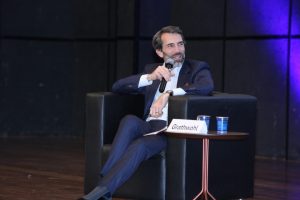
Kaspar Grathwohl, Executive Vice Chairman, UBS, Switzerland
Kyle Sokol, General Surgeon, Memorial Hospital of Converse County, USA, brought a different but complementary perspective from the field of medicine. He argued that innovation requires a culture of inquiry and courage to question entrenched assumptions. “Investigative thinking,” he said, “can change many businesses — and many lives.” His point was reinforced by Mikhail Higgins, President and Medical Director, Bahamas Fibroid & Interventional Clinic, Bahamas, who spoke about the transformative power of applying modern medical science to long-neglected public health issues. “My goal is to serve people through my skill set,” he explained. Adding a philanthropic and organizational perspective, Sandra Sokol, Executive Director, Converse County Hospital Foundation, USA, spoke about the power of collective action in building resilient health systems. Together, the panelists underscored that economic development in the age of cooperation must integrate vision with execution, values with value creation. Investment must empower people, innovation must serve humanity, and institutions must cultivate trust.
The session Shaping Humanity Together set a reflective and aspirational tone. Chaired by Natália Ariede, Anchor, CNBC, Brazil, the session explored what it truly means to design the future of humanity through empowerment, innovation, and inclusion. The speakers approached this question from markedly different worlds – from politics and philanthropy to social entrepreneurship and cultural activism – yet their visions converged on a shared belief: that lasting progress begins with individual agency and collective responsibility. Vít Jedlička, President, Liberland, opened the dialogue with a radical vision of freedom and governance. He spoke of Liberland – a micronation founded on the principles of minimal government and cryptocurrency – as a laboratory for reimagining the relationship between citizens and the state. Picking up the theme of empowerment, David Gershon, Founder, Empowerment Institute Center for Reinventing the Planet, USA, urged participants to shift from problem-solving to possibility-thinking. “If we focus on solutions, or what we want, we gain insight into those,” he said. “It is a more efficient use of our time and enables more dynamic growth to focus on a vision of what we want.”
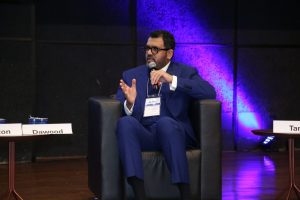
Ahmed Bin Dawood, Chief Executive Officer, BinDawood Holdings, Saudi Arabia
Martín Burt, Founder and Executive Director, Fundación Paraguaya, Paraguay, grounded the discussion in humility and inclusion. “We have to ask the poor what it means for them not to be poor,” he reminded the audience, “and include them in the design process of anti-poverty programs.” Burt’s words brought moral depth to the debate, reminding participants that cooperation must be anchored in listening. From a humanistic and cultural perspective, Indrani Pal-Chaudhuri, Founder, Open Origin, USA, spoke of education and creativity as the universal keys to empowerment. “Whatever you do, wherever you live, and whatever society you’re in, there is so much power you have as an agent of change,” she said. “Each of us has a responsibility to make the world a better place.” Her statement captured the panel’s essence: that humanity’s progress is not the task of institutions alone, but of every individual who chooses to act with awareness and compassion. Bringing an analytical yet impassioned close, Cordell Carter, Founder, The Festival of the Diaspora, USA, called for courage and imagination in philanthropy. “Philanthropy should be more risk-taking,” he declared. “Foundations are too often risk-averse, forgetting that their role is catalytic, not conservative.” Together, the panelists issued a resonant message: humanity’s progress depends on cooperation between freedom and responsibility, innovation and empathy, risk-taking and care. Their conversation reminded participants that shaping humanity’s future begins not with systems, but with a mindset – one that values courage over comfort and inclusion over control.
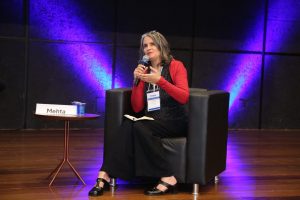
Jojo Mehta, Co-Founder and CEO, Stop Ecocide International, United Kingdom
The plenary Co-Creating Solutions for Global Challenge, was chaired by Catherine Carlton, Council Member and Former Mayor, Menlo Park, USA, bringing together voices that spanned from Silicon Valley to Riyadh, Beijing, Cape Verde, São Paulo, and Johannesburg – each offering a distinct yet harmonious perspective on how cooperation can translate global uncertainty into shared progress. Catherine Carlton opened the session by reflecting on the delicate balance between global innovation and local impact, drawing from her experience at the crossroads of technology and governance in California. “Global players and local communities must grow together,” she emphasized, “so that transformation does not overwhelm the residents it is meant to serve.” Her words set the tone for a conversation grounded in responsibility – one that sought to re-humanize growth. Ahmed Bin Dawood, Chief Executive Officer, BinDawood Holdings, Saudi Arabia, brought the conversation into the boardroom, where legacy meets transformation. Speaking candidly about family-owned enterprises navigating modern capital markets, he noted, “The majority of family businesses don’t survive the transition to the third generation.” For him, transparency and trust are the new cornerstones of longevity. From the Atlantic, Pedro Lopes, Secretary of State of Digital Economy, Cape Verde, offered a hopeful vision of how small nations can lead through agility and openness. “We believe we can be more flexible and faster than the others,” he said, describing Cape Verde’s emergence as a digital bridge between Africa, Europe, and the Americas – transforming historic routes of trade into new routes of knowledge and innovation. His country, he said, is determined to become “a global laboratory where cooperation replaces extraction.”

Tobias Ellwood, Former Minister for Defence Veterans, Reserves and Personnel, United Kingdom
Henry Wang, Founder, Center for China and Globalization, China, placed the discussion in a broader geopolitical frame. “The pandemic revealed not only the failure of globalization,” he said, “but the need to innovate global governance systems and boost international cooperation.” He urged a reinvention of globalization — not as an era that has ended, but as one evolving toward shared problem-solving and co-development. That bridge was vividly illustrated by Charles Tang, Chairman, Brazil-China Chamber of Commerce & Industry, Brazil, who reminded participants of the depth of Brazil’s economic partnership with China. “The benefits for Brazil are incalculable,” he said. “Last year we had almost US$80 billion in trade surplus with China, and the accumulated balance already surpasses US$500 billion. Rounding off the session, Nkululeko Khumalo, Chief Executive Officer, Mbulase Group, South Africa, turned attention to the future. Looking ahead to the G20 Summit in Johannesburg — the first to be held in Africa — he described it as “a realization by global powers that collaboration must extend beyond the usual suspect areas.” Africa, he said, is ready to shape solutions that are globally relevant and locally tested.“
The meeting’s summary plenary, Cooperation is a Strength, not a Weakness, brought together an atmosphere of reflection and renewal as delegates considered the key takeaways from three days of dialogue. Chaired by Mariana Luz, Chief Executive Officer, Maria Cecilia Souto Vidigal Foundation, Brazil, the session reaffirmed that cooperation is not merely an ethical ideal but an operational necessity in a world of intertwined risks. Luz, known for her advocacy of early childhood development and social transformation through collective effort, emphasized the urgency of citizen engagement: “Public mobilization is fundamental to a behavior change. The risk that the climate issue can bring to business, in terms of impacting economic returns, is real.
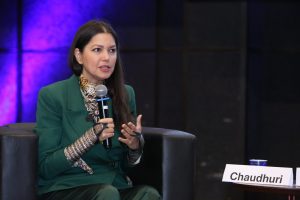
Indrani Pal-Chaudhuri, Founder, Open Origin, USA
Jojo Mehta, Co-Founder and CEO of Stop Ecocide International, framed cooperation within the rule of law, arguing that moral renewal requires legal redefinition. “Criminal law has a particular role to play because we use criminal law to draw moral lines,” she said. “Changing a law doesn’t cost very much money, but the effect is enormous. It would change where investments go, where decision-makers focus, and how we judge right and wrong.” Tabata Amaral, Federal Deputy, Brazil, brought a generational and political dimension to the discussion. One of the youngest elected officials in Brazilian Congress, Amaral has become a voice for democratic renewal and the inclusion of youth in decision-making. She called for rebuilding the social fabric necessary for collective problem-solving: “For cooperation to happen, we need some consensus – and we’ve lost those spaces of consensus-building.” She argued that polarization, amplified by disinformation, weakens societies’ ability to mobilize toward shared goals. Marcelo Zuffo, President of Inova USP and a pioneer of Brazil’s digital transformation, linked these moral and political insights to innovation. He argued that technology must be “socially relevant, not just advanced.” For him, cooperation is the foundation of innovation ecosystems, where academia, industry, and government form a single learning community.
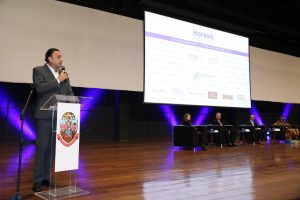
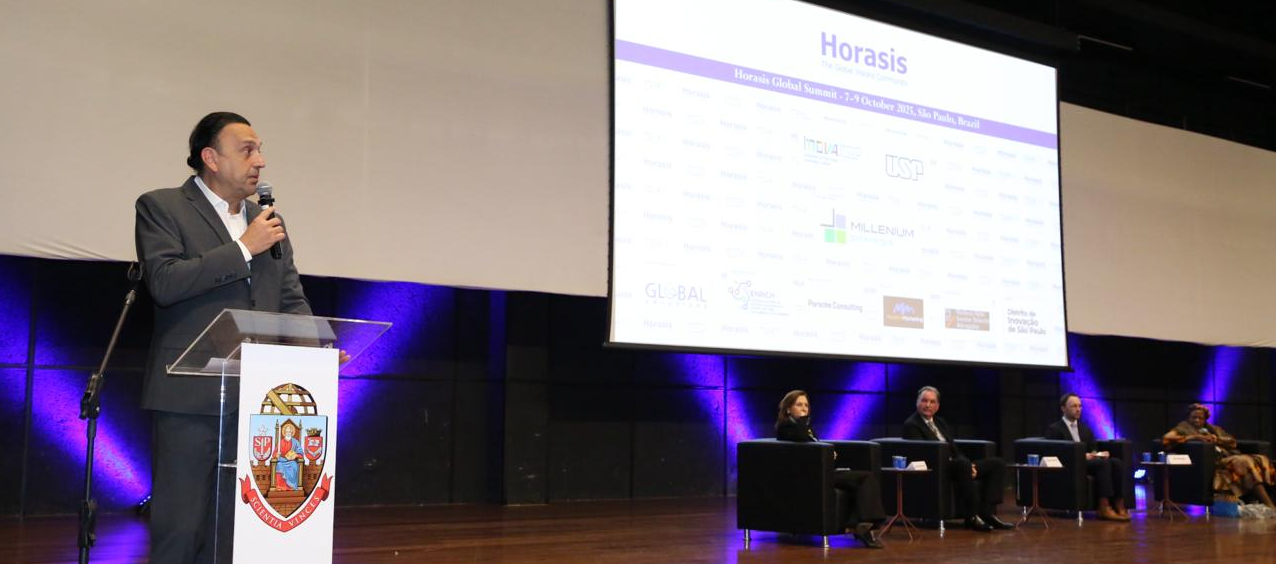
Felício Ramuth, Vice Governor of the State of São Paulo, during the Grand Opening
Benjamin J. Butler, Founder, Embassy of the Future closed the panel as its rapporteur. A futurist known for his work on global foresight and narrative change, Butler urged participants to see cooperation as an act of imagination: “If you can’t imagine a positive future, how can you create one?” As the plenary drew to a close, several key participants gathered on stage – political leaders, entrepreneurs, and policymakers – symbolically joining hands to reaffirm the spirit that had animated the three days in São Paulo. Their gesture embodied the Summit’s conviction that cooperation is not a passive agreement but a living force, one that grows stronger through shared purpose. The closing moments were marked by a deeply moving song led by Alves de Almedida Katukina Renaldo, Chief and Shaman of the Sacred Village, Peru. His voice, carrying ancestral resonance, filled the hall with a sense of unity that transcended language and geography. As the final notes lingered, delegates stood together in quiet reflection, aware that the challenges ahead are vast – but also that cooperation, as both strength and promise, remains humanity’s most enduring tool for transformation.
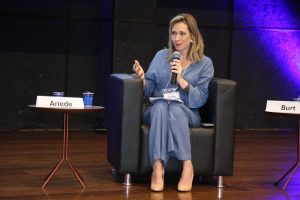
Natália Ariede, Anchor, CNBC, Brazil chairing the plenary panel Shaping Humanity Together
I would like to express my sincere appreciation to the Government of the State of São Paulo and its Governor, Tarcísio de Freitas, for his foresight in inviting Horasis to convene in this remarkable city – a global hub of innovation and resilience. His commitment to fostering dialogue between public institutions, academia, and business stands as an inspiring example of how visionary leadership can transform cooperation into action. I also wish to extend my deepest gratitude to all those who made this historic edition possible: Professor Marcelo Zuffo, President of Inova USP, whose vision and hospitality gave our gathering its intellectual home; Jan Eichbaum, President of the European Network of Research and Innovation Centres, whose dedication turned the Summit into a reality; Carolina da Costa, Chief Impact Officer, Stone, Anastasia Kalinina, Founder of the SuperSymmetry Institute, Switzerland, Rüdiger Leutz, Managing Director, Porsche Consulting, Brazil, Mahesh M. Gandhi, President of AFII Capital, Germany, Mauricio Prazak & Karen Schneider of IBREI, for their enduring support and engagement. My special thanks go as well to Jerry Zhang, Parag Amin, and Ani & Joe Honan for their support and friendship.
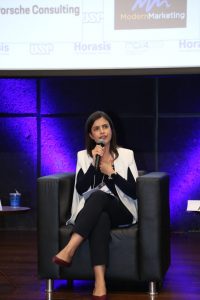
Tabata Amaral, Federal Deputy – one of the youngest elected officials in Brazilian Congress
Throughout the Summit, we were reminded that cooperation is not a sign of weakness, but a profound strength – the courage to trust, to share, and to act together for the greater good. In an age marked by uncertainty and fragmentation, it takes vision to cooperate, humility to listen, and determination to build together. True progress begins when leaders move beyond competition and rediscover the power of common purpose.
This year’s Horasis Global Summit – our tenth, and the twentieth anniversary of the Horasis Global Visions Community – has shown that the world is not short of ideas or innovation, but of trust. And trust is born not in isolation, but in encounter – when people meet, exchange, and see their own hopes reflected in the eyes of others. Brazil, with its energy, diversity, and resilience, offered us the ideal stage to renew this spirit. Here in São Paulo, we have seen that cooperation is not an abstract aspiration but a living practice – one that unites policymakers, entrepreneurs, and citizens in shaping a fairer and more sustainable future.
As we look ahead, Horasis will continue to serve as a platform for this shared endeavor; bridging continents, industries, and cultures, and helping to shape a world where growth regenerates what it touches. We shall deepen our commitment to dialogue that inspires, partnerships that endure, and solutions that uplift. Our task is not only to anticipate the future but to imagine it together – to transform cooperation from a response to crisis into a permanent architecture of hope.
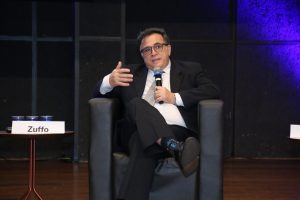
Marcelo Zuffo making a point on a plenary panel
Horasis looks forward to welcoming its global community once again at the next edition of the Horasis Global Meeting – to continue our dialogue, renew our commitment, and transform cooperation into lasting impact. For it is only by being together, and by believing in one another, that we can truly harness the power of cooperation.
Featured photo: Felício Ramuth, Vice Governor of the State of São Paulo, during the Grand Opening