Inventors of Tales: Writing a Second Opportunity on Earth

By Benjamin J Butler, Futurist, United Kingdom
November 16, 2026
What is the most powerful technology known to humanity?
We have heard a great deal about artificial intelligence in Medellin. But there is one technology more powerful still, and far more ancient.
If you can’t guess it now, I will come back to it at the end.
Time Travelling: Leading from the Future
At the opening of the Horasis Global Meeting in Medellín, the Embassy of the Future invited participants to travel to 2070, to imagine a world worth living in, and to come back with insights for today. The exercise was playful, but its purpose was serious. Most of our decisions are made from inside the walls of the present: this quarter’s numbers, this year’s crisis, the limits of what seems realistic. Looking back from the future lets us lead from where we want to go, not from where we are stuck.
Many of you will know One Hundred Years of Solitude, the masterpiece of Colombia’s most celebrated writer. It tells the story of the fictional town of Macondo and the Buendía family across a hundred years. Through Macondo, we live some of the most painful chapters of Colombian history: civil wars, foreign exploitation, violence and forgetting.
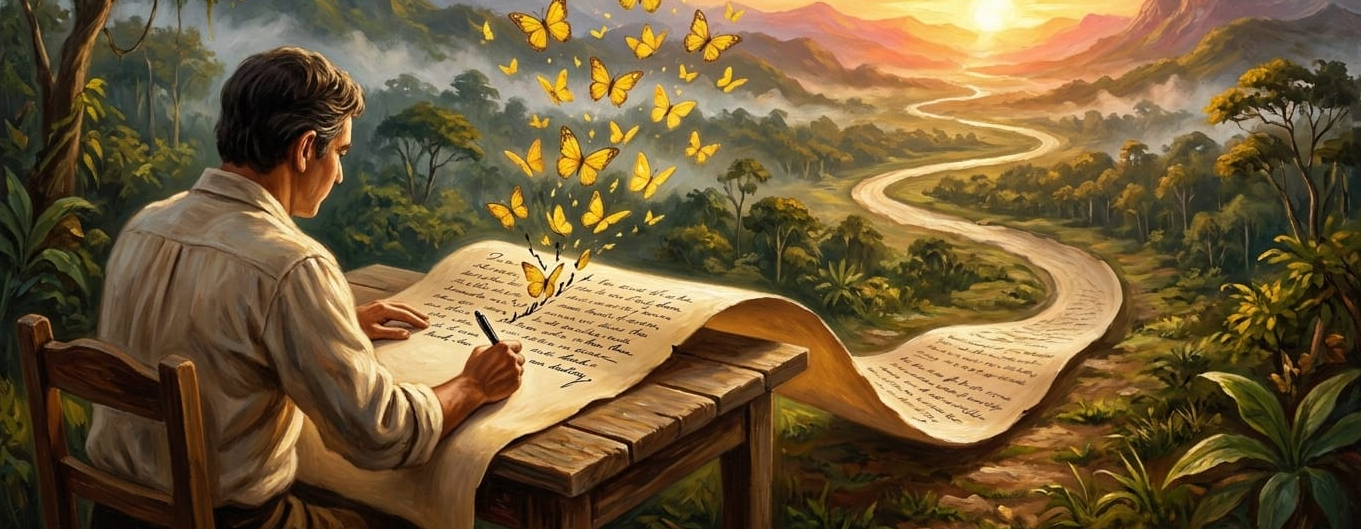
It felt right, at the close of the meeting, to return to that idea through a son of this land. When the author of that highly acclaimed novel Gabriel García Márquez accepted the Nobel Prize for Literature in 1982, he ended his lecture with these words:
“We, the inventors of tales, who will believe anything, feel entitled to believe that it is not yet too late to engage in the creation of the opposite utopia. A new and sweeping utopia of life, where no one will be able to decide for others how they die, where love will prove true and happiness be possible, and where the races condemned to one hundred years of solitude will have, at last and forever, a second opportunity on earth.”
Rewriting the ending
To feel the full force of that passage, it helps to remember how One Hundred Years of Solitude ends. Over seven generations, the Buendía family repeats the same names, the same passions and the same mistakes. Time in Macondo runs in circles. Across those hundred years, the town lives through civil wars, the arrival and exploitation of a foreign banana company, a massacre of striking workers that is erased from memory, and long periods of decay. In many ways it is the story of Colombia itself: a very hard and painful history. In the final pages, the last Aureliano deciphers the parchments of the gypsy Melquíades and discovers that his family’s whole history was foretold. As he reads, a great wind wipes Macondo from the face of the earth, and the novel tells us that those condemned to a hundred years of solitude would have no second opportunity.
For García Márquez, solitude was not the gentle pleasure of time alone. It was a curse: the inability to love, to connect, and to learn from the past, and so the fate of repeating it. He described solitude as the opposite of solidarity. In his Nobel lecture he widened the idea to a whole continent, misunderstood and unheard by the rest of the world.
Then, standing at the podium in Stockholm, he did something remarkable. He rewrote his own ending. The novel had closed the door; the speech opened it again. The races condemned to solitude would, after all, have a second opportunity on earth.
This, to me, is one of the most important messages we can carry into the coming decades – not only for Latin America but for the whole world. We are the authors of our own story. We can write our future – and we can even rewrite our past. That does not mean denying pain or erasing suffering. It means reframing it, so that what wounded us becomes the beginning of something new rather than a sentence we are condemned to repeat. Individuals can do this. So can cities, nations and civilisations.
Lessons of Water
Medellín is called the City of Eternal Spring, and as I moved through it, with rivers and streams flowing down from the surrounding mountains, I kept thinking about water.
I used to live in Asia for nearly 25 years and I am influenced by Taosim, Zen and Eastern philosophy. The Tao often points to the wisdom of water. Bruce Lee, the great martial artist, is said to have had his breakthrough while watching water in Hong Kong Harbour. Water does not fight obstacles. It flows around them, finds the openings, and over time reshapes the hardest rock. “Be like water,” he told us.
Water teaches us that softness can be stronger than force: drop by drop, it carves canyons. It teaches us adaptability, taking the shape of whatever holds it without losing its essence. It teaches us connection, because every stream eventually joins a river and every river the sea. And it teaches us that life follows it: wherever water flows, things grow. In a time of upheaval, these may be exactly the qualities we need.
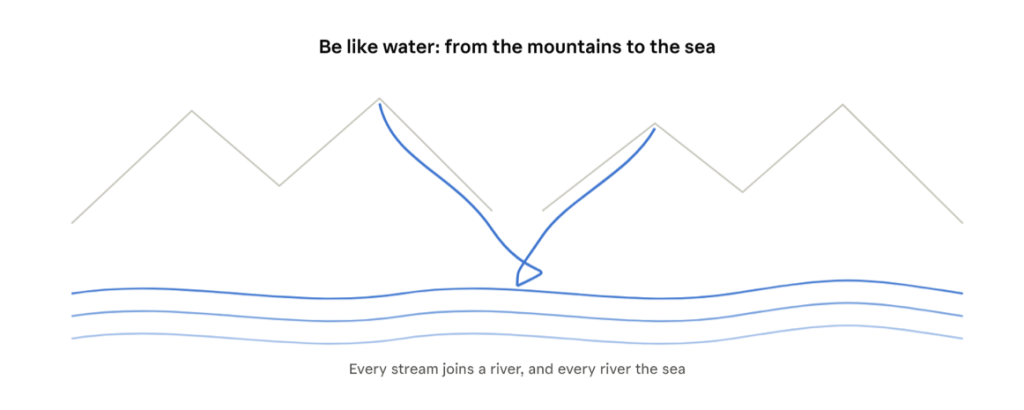
Be like water · mountains, rivers and the sea
Water teaches us something else, too. When it is heated past a certain point, it becomes steam. Physicists call this a phase transition. It is not simply more of the same; it is a change of state. Steam no longer obeys the rules that governed water. Its molecules behave in a completely different way.
I believe humanity is now passing through a phase transition of its own, perhaps a once-in-ten-thousand-year moment. I have been speaking about this since the global financial crisis, and the signs have only grown clearer. The rules that governed the old system are breaking down, and new ones are emerging. Five tectonic forces, at least, are causing this evolutionary moment.
Five tectonic forces
The first is artificial intelligence, possibly the most powerful technology humanity has ever created. It forces us to ask what intelligence really is. It will bring immense disruption to work, institutions and identity, and ultimately it also brings real opportunity.
The second is the end of five hundred years of Western dominance. Ancient civilisational powers such as China and India are re-emerging, indigenous wisdom is being heard again, and we are moving into a multipolar world in which many more voices can shape the future.
The third is economic and financial. The current system is no longer working for most people. Inflation is in the pipeline and has already begun to show itself, while wealth and income are concentrated in ever fewer hands.
The fourth follows from the third: the breakdown of social cohesion. Economics is part of it, but so is culture, the sheer pace of change, and an information revolution comparable to the one unleashed by Gutenberg’s printing press. We should expect more civil discord, and perhaps revolutions, around the world.
The fifth is the ecological crisis, which will only intensify over time. In the short term, we are living through a super El Niño: researchers at the University of Chicago’s Climate Impact Lab project some 451,000 additional heat deaths worldwide between September 2026 and February 2027, on top of the droughts, floods and wildfires it brings. Over the longer term, we may be crossing even larger tipping points in the Earth’s systems, changes that cannot easily be reversed.
The new rules
This could sound like a story of collapse, and in part it is. Many people now speak of the end of industrial civilisation. But a phase transition is also a birth. In the middle of the breakdown, we can look ahead to the world on the other side and begin living by its rules today.
The old rules were built on command, control, coercion and separation. The emerging rules rest on regeneration, nurture and the understanding that everything is interconnected. That is why I speak not only of an ending but of a transformation: from industrial civilisation towards ecological civilisations.
History suggests that in revolutionary times, it is often the poets, artists, musicians and storytellers who lead the way. They give us the images and narratives that allow people to imagine a different world, and they bring us together. García Márquez called them inventors of tales. We need them now more than ever, because a civilisation in transition needs new stories before it can build new institutions.
Multiple Forms of Intelligence
Today, China and the United States appear to be racing to dominate artificial intelligence. In a recent Foreign Affairs essay, “Empires of AI,” the historian Niall Ferguson, former Google CEO Eric Schmidt and researcher Lisa Klaassen argue that AI is an inherently imperial technology. They even compare today’s leading AI labs to the East India Companies of the colonial era. It is the old logic of domination and extraction, now dressed in silicon.
Artificial intelligence is only one kind of intelligence. If the future we imagine is nothing but silicon and algorithms, it is not a very inspiring one. AI is a tool, and a valuable one. It can make our systems more efficient, speed up science and help us face the ecological crisis. Yet the future will be shaped just as much by our capacity to work together as communities.
This is where Latin America, and Colombia in particular, has so much to offer.
The first is social intelligence. Medellín is a living testament to what communities can achieve through social innovation, and listening to the Comfama group during the meeting was a vivid reminder of it.
One of my favourite examples of Colombian social intelligence and innovation comes from Bogotá. In the 1990s, faced with chaotic roads, many traffic deaths and a notoriously corrupt traffic police, Mayor Antanas Mockus did something no algorithm would have suggested: he replaced traffic officers with mimes. The mimes playfully mocked drivers and pedestrians who broke the rules and applauded those who behaved well, and citizens were given cards to show approval or disapproval. Mockus believed people feared being laughed at more than being fined. It was a lesson in changing behaviour through culture, humour and shared norms rather than through punishment alone.
The second is natural intelligence. Colombia is one of the most biodiverse countries on earth, a vast library of solutions that nature has refined over millions of years.
The third is ancestral intelligence. Indigenous peoples such as the Kogi of the Sierra Nevada de Santa Marta still carry a deep understanding of how humans can live in balance with the land.
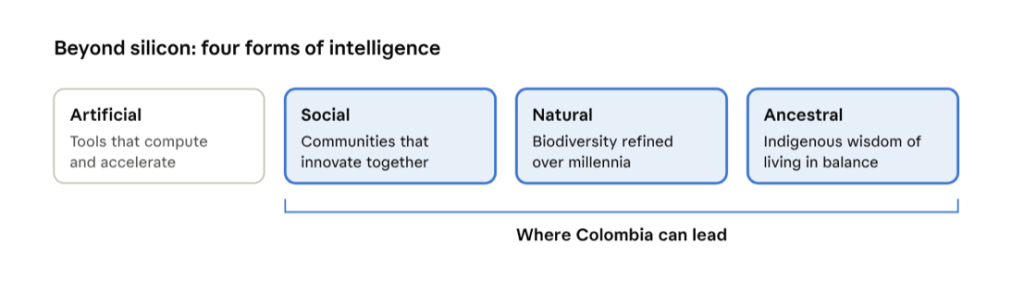
Four forms of intelligence · Colombia’s three strengths highlighted
Where the Eagle and the Condor meet
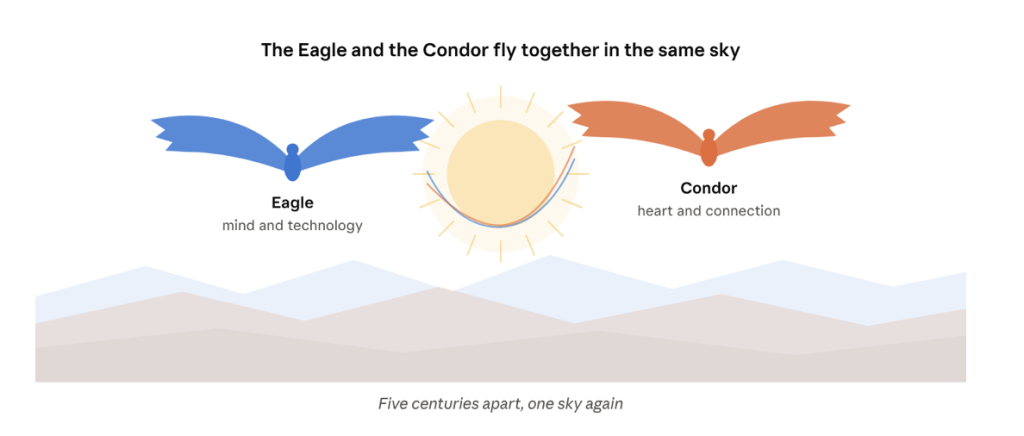
The Eagle and the Condor · flying together over the Andes
Many people in the Americas know the prophecy of the Eagle and the Condor. It has many interpretations. In one, the peoples of the Eagle and the peoples of the Condor were separated five hundred years ago. The Eagle represents the path of the mind and technology; the Condor, the path of the heart and connection. For five centuries, the Eagle dominated. The prophecy says that this era is ending, and that the Eagle and the Condor will fly together again in the same sky.
For me, this prophecy is not only a beautiful story; it is a way of life I am striving to embody. I spend six months or more of each year in Peru, the land of the Condor, and the rest back in Europe, in the UK and elsewhere, in the lands of the Eagle. Moving between the two has taught me how much each needs the other: the precision, innovation and ambition of the Eagle, and the reciprocity, reverence for nature and sense of community that run so deep in the Andes, land of the Condor. Neither alone can carry us through this transition. Together, they can.
I cannot think of a better image for the transition we are living through. We do not need to choose between technology and wisdom, or between the mind and the heart. We need them to fly together. I believe Colombia can be one of the places where the Eagle and the Condor meet.
A second opportunity
Let us be inventors of tales, telling stories of the future that are worth living into. And let us remember the lesson García Márquez gave us when he rewrote his own ending. The past does not have to be our destiny. Solitude can give way to solidarity.
So, what is the most powerful technology known to humanity? Not artificial intelligence. It might be storytelling. The stories we tell shape what we believe is possible, and what we believe is possible shapes what we build. Together, we can write the story in which humanity, at last and forever, has a second opportunity on earth.